
The Day America Won the Wine World
On May 24, 1976, the now-famous “Judgment of Paris” blind tasting shocked the wine world when California wines defeated top French wines in front of elite French judges in Paris. Organized by British wine merchant Steven Spurrier, the event proved that American winemakers could compete at the highest level of global wine production. The victory permanently changed the reputation of the U.S. wine industry and helped establish California as one of the world’s premier wine regions.
What Actually Happened That Day
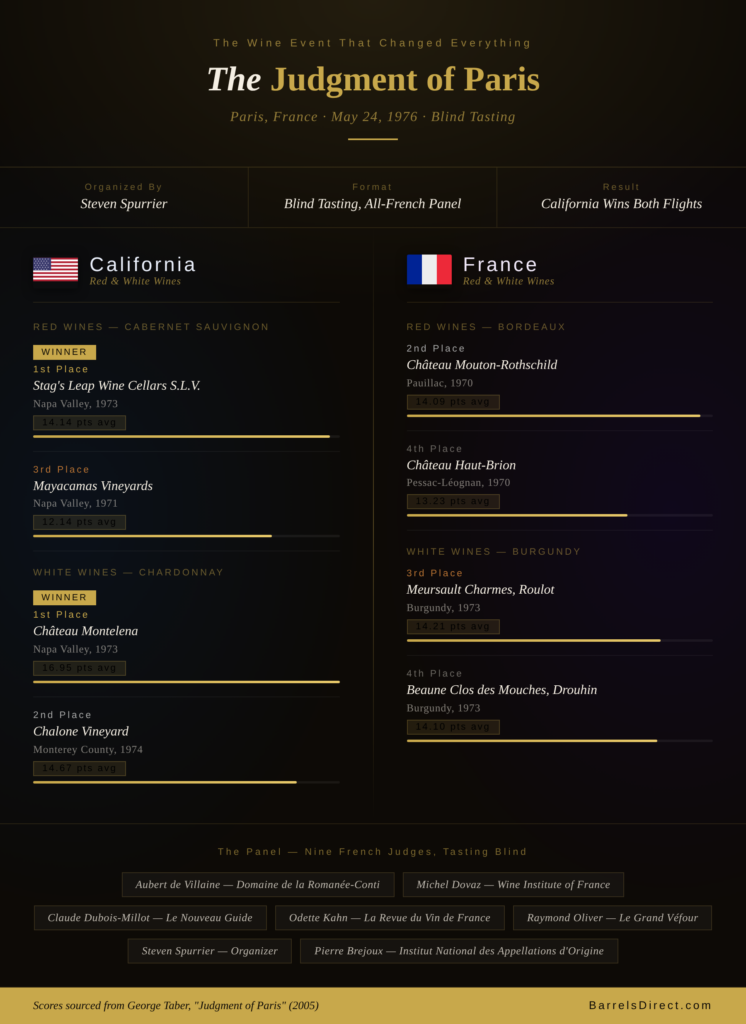
Steven Spurrier was an Englishman running a wine shop and school in Paris. He’d been watching California winemakers bring their bottles to him and was quietly impressed enough to do something about it. To mark the American Bicentennial, he put together a blind tasting. California’s best Cabernet Sauvignons and Chardonnays against the gold standard of the wine world: Bordeaux reds and white Burgundies.
The panel was entirely French. These weren’t amateurs. We’re talking leading figures from La Revue du Vin de France, the sommelier of La Tour d’Argent, and the co-director of Domaine de la Romanée-Conti. If anyone was going to recognize and reward great French wine, it was this group. And they did. They just didn’t know they were handing top marks to Napa Valley.
When the scores were tallied, the room went quiet. Stag’s Leap Wine Cellars 1973 Cabernet Sauvignon topped the reds, above Mouton-Rothschild and Haut-Brion. Château Montelena’s 1973 Chardonnay topped the whites, above the finest Grand Cru Burgundies in the world. The sole journalist in the room, George Taber of Time Magazine, ran the story. The French wine press mostly looked the other way. The rest of the world could not.
Why This Mattered for All of Us
Before May 24th, 1976, the idea that great wine could come from anywhere but France wasn’t taken seriously at the highest levels. Bordeaux for your reds. Burgundy for your whites. Champagne for your bubbles. American wine was what you drank when you couldn’t afford the real thing.
The Judgment of Paris blew that door open and it never closed again. It announced, in front of the people who mattered most, that the terroir, the talent, and the ambition existed right here on American soil. The French themselves confirmed it, without even knowing it.
Investment poured into Napa and Sonoma. French winemakers started making trips west to see what was going on. Opus One, the joint venture between Robert Mondavi and Baron Philippe de Rothschild, launched its first vintage in 1979. No coincidence there. The world had recalibrated.
It proved that American producers could work with the same varietals, the same barrel-aging traditions, and the same winemaking philosophy as the Old World, and do it on their own terms.
The Barrel Connection
Many of the world’s most celebrated wines and fortified wines have American counterparts that are genuinely impressive. California and the broader U.S. wine country have been producing their own versions of these storied styles for decades. And because these wines are made right here at home, the barrels behind them are far more accessible and far more affordable than anything coming off a boat from Europe.
Port-Style Fortified Wines Producers in California, Oregon, and Virginia are crafting stunning Tawny and Ruby-style fortified wines from Touriga Nacional and Zinfandel. Aged in standard barrels and larger puncheons sourced domestically, at a fraction of what imported casks run.
Sherry-Style Wines Oxidative-aged, flor-influenced American Sherries are a real and growing category. California producers are replicating the solera style using American and French oak barrels sourced through domestic coopers at prices that actually make sense.
American Brandy and Cognac-Style Spirits Craft distillers across the country are producing serious Cognac-inspired grape brandies aged in new and used American and French oak. The quality has risen dramatically over the last decade, and the barrel costs are a fraction of importing Limousin oak from France.
Sauternes-Style Dessert Wines Late-harvest and botrytized wines from California, Washington, and New York are producing bottles that rival Sauternes in character and complexity. The barrels behind them, both French and American oak, are sourced right here without the transatlantic markup.
Time in wood is the thread that runs through all of it, Old World and New. American white oak is world-class cooperage. From Kentucky to Missouri to California, domestic barrels age some of the most sought-after wines and spirits on the planet. French oak is also available domestically, crafted right here by skilled American coopers.
The economics always come up in these conversations. A top-tier French Limousin oak barrel can run over $1,000 landed. A quality barrel from a domestic cooper? A fraction of that.
The Legacy Is Still Being Written
At the 30th anniversary retasting in 2006, using the same wines now decades in bottle, California didn’t just hold its own. It took over. Four of the top five spots went to California reds. The highest-ranked Bordeaux came in sixth. The French judges, many of them there in 1976, had to concede the point all over again.
That’s no fluke. That’s a tradition. An American wine tradition built on great fruit, great winemaking, and great barrels.